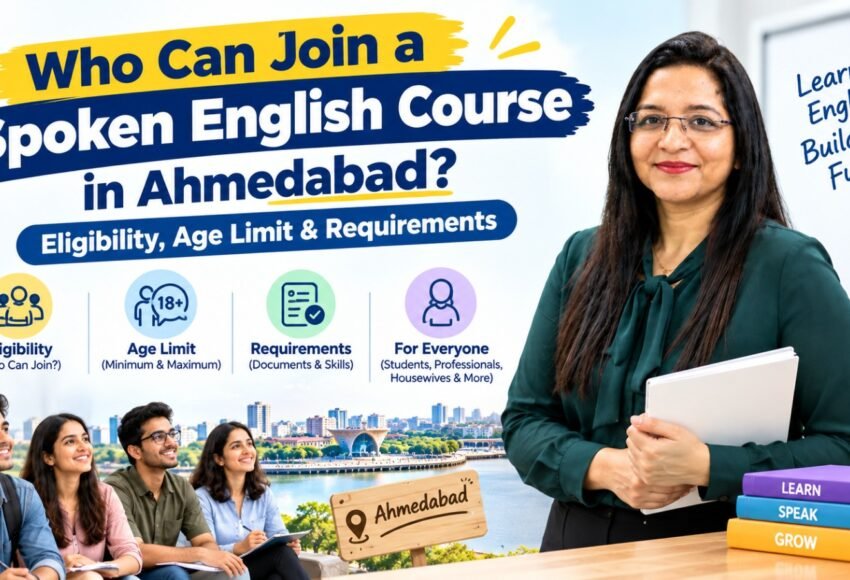
Who Can Join a Spoken English Course in Ahmedabad? Eligibility, Age Limit & Requirements
Good English communication can be useful for education, employment, interviews, business communication and everyday conversations. But many people hesitate to join an English-speaking course because they are unsure whether they meet the eligibility requirements.
The good news is that Spoken English courses are generally suitable for learners from different educational and professional backgrounds. Students, graduates, job seekers, working professionals and adults can all benefit from structured English communication training.
This guide explains who can join a Spoken English course in Ahmedabad, whether there is an age limit, what educational qualifications are generally required, what beginners need to know before joining and how to select the right course according to your learning level.
Who Can Join a Spoken English Course in Ahmedabad?
A Spoken English course is designed to improve practical communication rather than simply teach textbook English.
Depending on the institute and course level, the following learners may be eligible:
- School students
- Class 10 pass students
- Class 12 pass students
- College students
- Graduates and postgraduates
- Job seekers
- Freshers
- Working professionals
- Entrepreneurs and business owners
- Homemakers
- Adults looking to improve communication
- Learners preparing for interviews or presentations
The exact eligibility criteria depend on the institute, but many general Spoken English programs are designed for learners with different educational backgrounds.
Is There an Age Limit for a Spoken English Course?
There is no single age limit that applies to every Spoken English course.
English can be learned at almost any stage of life. However, training institutes may divide learners into different batches according to age, learning level or purpose.
For example:
| Learner Group | Suitable Learning Focus |
|---|---|
| School Students | Basic grammar, vocabulary and conversation |
| Teenagers | Speaking confidence, pronunciation and communication |
| College Students | Presentation, GD, interviews and fluency |
| Graduates | Workplace and professional communication |
| Job Seekers | Interview and workplace English |
| Working Professionals | Meetings, presentations and business communication |
| Adults | Everyday conversation and confidence |
| Entrepreneurs | Client communication and professional English |
Some institutes may have a minimum age requirement for a particular batch, so it is useful to confirm the age criteria before admission.
Can Students Join a Spoken English Course?
Yes. Students are among the common learners who choose Spoken English training.
For students, the course can focus on:
- Basic and advanced grammar
- Vocabulary development
- Sentence formation
- Pronunciation
- Listening skills
- Everyday conversations
- Public speaking
- Presentation skills
- Group discussions
- Interview communication
- Confidence building
Students can use these skills during classroom presentations, college activities, interviews and other communication situations.
Can Students Join After Class 10?
In many cases, Class 10 pass students can join a general Spoken English course, particularly beginner-level programs.
The course can help them build a foundation in:
- Basic grammar
- Common vocabulary
- Sentence construction
- Speaking practice
- Listening
- Pronunciation
- Everyday English
However, individual institutes may have their own minimum-age or admission requirements.
Students should choose a course according to their current English level rather than selecting an advanced program simply because they have completed Class 10.
Can Students Join After Class 12?
Yes. Class 12 pass students can generally consider Spoken English training.
A course after 12th can be useful for students preparing for:
- College education
- Job interviews
- Competitive environments
- Presentations
- Group discussions
- Customer-facing roles
- Professional communication
For students after Class 12, an ideal course may combine general speaking practice with presentation, interview and workplace communication.
Can College Students Join a Spoken English Course?
Absolutely.
College students may already understand English grammar but still feel uncomfortable speaking it. A practical Spoken English course can help bridge the gap between knowing English and using English confidently.
College-level training may include:
- Conversational English
- Advanced vocabulary
- Presentation skills
- Group discussions
- Public speaking
- Interview communication
- Pronunciation
- Listening practice
- Professional introductions
- Workplace communication
Regular speaking activities are particularly useful because fluency develops through practice, not only through reading grammar rules.
Can Graduates Join a Spoken English Course?
Yes. Graduates from different academic backgrounds can join Spoken English courses.
A graduate may choose training to improve communication before entering the job market or moving into a professional role.
Useful modules may include:
- Professional introductions
- Email communication
- Interviews
- Presentations
- Meetings
- Group discussions
- Workplace vocabulary
- Customer communication
- Public speaking
- Professional confidence
The course does not usually require a specific graduation stream unless it is a specialized program.
Can Working Professionals Join?
Yes. Many Spoken English programs are suitable for working professionals.
Professionals may want to improve English for:
- Workplace conversations
- Team meetings
- Client communication
- Presentations
- Telephone conversations
- Emails
- Interviews
- Leadership communication
- Business discussions
- Career development
Working professionals can look for institutes offering weekday evening or weekend batches if their work schedule makes regular daytime classes difficult.
Can Job Seekers Join a Spoken English Course?
Yes. Job seekers can use Spoken English training to strengthen communication skills that may be useful during recruitment processes.
A career-focused course may include:
- Self-introduction
- Interview questions
- Mock interviews
- Group discussions
- Resume-related communication
- Professional vocabulary
- Confidence-building exercises
- Presentation practice
- Workplace conversations
However, Spoken English is one part of employability. Technical knowledge, qualifications, experience and job-specific skills can also influence employment opportunities.
Can Beginners Join Without Knowing English Well?
Yes. Beginners are one of the main groups for whom Spoken English courses are designed.
A beginner course generally starts with fundamental concepts such as:
- Alphabet and basic pronunciation
- Common words
- Basic grammar
- Parts of speech
- Tenses
- Sentence formation
- Question formation
- Everyday vocabulary
- Listening
- Simple conversations
Learners should not feel that they need to speak fluent English before joining a Spoken English class. The purpose of a beginner course is to help develop those skills gradually.
Do You Need Any Educational Qualification?
For most general Spoken English courses, a specific degree is not normally required.
Institutes may accept learners from different educational backgrounds. However, requirements can vary depending on the course.
For example:
| Course Type | Typical Requirement |
|---|---|
| Basic Spoken English | Usually no specific qualification |
| Beginner English | Basic understanding may be helpful |
| Intermediate English | Basic English knowledge may be expected |
| Advanced Communication | Intermediate English may be recommended |
| Business English | Basic/intermediate communication may be useful |
| Professional Communication | Requirements vary by institute |
Always check the institute’s admission criteria before enrolling.
Do You Need to Know Basic English Before Joining?
Not necessarily.
If you are a complete beginner, look for a course specifically labelled Beginner, Basic Spoken English or Foundation English.
If you already understand English but hesitate while speaking, an intermediate communication course may be more suitable.
A simple level assessment or demo class can help determine where you should start.
What Are the Main Requirements for Joining?
Although requirements vary, a general Spoken English course may require only a few things:
1. Basic Learning Interest
You should be willing to participate and practise regularly.
2. Suitable English Level
Institutes may assess whether you are a beginner, intermediate or advanced learner.
3. Regular Attendance
Speaking skills improve through repeated practice, so consistent attendance can be important.
4. Active Participation
Conversation activities, role plays and presentations are more effective when learners actively participate.
5. Practice Outside Class
Regular speaking, listening, reading and vocabulary practice can support classroom learning.
6. Course-Specific Documents
Some institutes may ask for basic registration information or identification documents. Requirements differ by provider.
Spoken English Course Eligibility by Learner Type
| Learner | Generally Suitable? | Recommended Focus |
|---|---|---|
| School Student | Yes | Foundation English |
| Class 10 Pass | Yes | Basic communication |
| Class 12 Pass | Yes | Speaking + academic/professional communication |
| College Student | Yes | Fluency + presentation |
| Graduate | Yes | Professional communication |
| Job Seeker | Yes | Interview + workplace English |
| Working Professional | Yes | Business/workplace communication |
| Homemaker | Yes | Everyday conversation |
| Senior Adult Learner | Often yes | Practical communication |
The exact age, batch and admission criteria should be confirmed with the institute.
What Should You Check Before Joining?
Eligibility is only one part of choosing the right Spoken English course.
Before enrolling, check:
Course Level
Make sure the course matches your current English ability.
Syllabus
Look for grammar, vocabulary, speaking, listening, pronunciation and practical conversation.
Speaking Practice
A course focused only on written grammar may not provide enough speaking exposure.
Trainer Support
Ask whether trainers provide individual feedback and correct common speaking mistakes.
Batch Size
Smaller batches may provide more opportunities for learners to speak.
Duration
Choose a duration that matches your goal and available time.
Class Schedule
Working professionals may prefer evening or weekend classes.
Certification
Ask what certificate is provided, who issues it and whether it represents course completion or a formal language qualification.
Fees
Compare what is included rather than looking only at the lowest advertised price.
Demo Class
If available, attend a demo session before making a decision.
Online or Classroom Spoken English Course: Which Is Suitable?
Both formats can work, depending on your learning preferences.
| Factor | Online | Classroom |
|---|---|---|
| Location | Learn from anywhere | Travel to institute |
| Flexibility | Usually higher | Depends on batch schedule |
| Interaction | Online speaking activities | Face-to-face activities |
| Convenience | High | Requires commuting |
| Practice | Depends on course design | Direct classroom interaction |
| Suitable For | Busy learners and remote learners | Learners who prefer in-person practice |
The quality of the course, trainer interaction and amount of speaking practice can matter more than the format alone.
How Long Does It Take to Complete a Spoken English Course?
There is no single standard duration.
Depending on the level and course structure, programs may range from approximately 1 to 6 months or longer.
| Course Level | Common Duration |
|---|---|
| Basic | 1–2 months |
| Beginner | 2–3 months |
| Intermediate | 2–4 months |
| Advanced | 3–6 months |
| Comprehensive | 4–6+ months |
Duration alone does not determine fluency. Regular practice and active speaking are important parts of language development.
How Much Does a Spoken English Course Cost in Ahmedabad?
Fees vary according to the institute, course level, duration, class format and trainer support.
Indicative ranges may look like this:
| Course Level | Indicative Fees |
|---|---|
| Basic | ₹3,000–₹8,000 |
| Beginner/Intermediate | ₹6,000–₹15,000 |
| Advanced | ₹10,000–₹20,000 |
| Comprehensive | ₹15,000–₹25,000+ |
These are indicative ranges, not fixed Ahmedabad-wide prices. Individual institutes may charge more or less depending on their course structure.
Who Should Consider Joining a Spoken English Course?
A Spoken English course may be useful if you:
- Understand English but hesitate to speak
- Want to improve pronunciation
- Struggle to form sentences quickly
- Want better vocabulary
- Need confidence for interviews
- Want to improve workplace communication
- Need presentation practice
- Want to participate more comfortably in conversations
- Are preparing for college or employment
- Want structured guidance instead of learning alone
A Simple Learning Roadmap for Beginners
If you are starting from a basic level, a practical learning path can be:
Step 1: Learn basic grammar
↓
Step 2: Build everyday vocabulary
↓
Step 3: Practise sentence formation
↓
Step 4: Start daily conversations
↓
Step 5: Improve pronunciation and listening
↓
Step 6: Practise presentations and discussions
↓
Step 7: Develop professional communication
This approach helps learners gradually move from understanding English to using it more confidently.
Spoken English Course in Ahmedabad: Who Can Join?
The eligibility for a general Spoken English course is usually broad. Students, Class 10 and Class 12 pass learners, college students, graduates, job seekers, working professionals and adult learners can often join, provided they meet the institute’s specific age and admission criteria.
There is generally no universal upper age limit for learning Spoken English. The most important factor is choosing a course that matches your current level and communication goal.
AIO: Quick Answers for Search and AI Results
Who can join a Spoken English course in Ahmedabad?
Students, graduates, job seekers, working professionals and adults can generally join a Spoken English course. Exact eligibility depends on the institute and course level.
What is the age limit for a Spoken English course?
There is no universal age limit. Some institutes may have minimum-age requirements or separate batches for children, teenagers and adults.
Can I join after 10th?
Yes, many beginner-level Spoken English courses may be suitable after Class 10, subject to the institute’s admission criteria.
Can I join after 12th?
Yes. Class 12 pass students can join Spoken English courses to develop communication, presentation, interview and professional English skills.
Can a graduate join a Spoken English course?
Yes. Graduates can join to improve professional communication, interviews, presentations and workplace English.
Can working professionals join?
Yes. Evening, weekend and online batches may be suitable for professionals with busy schedules.
Do I need a degree?
Generally, no. Most basic and general Spoken English courses do not require a specific degree.
Can beginners with weak English join?
Yes. Beginners should choose a foundation or basic Spoken English course designed for their current level.
FAQs
1. Is there any minimum age for a Spoken English course?
The minimum age depends on the institute and batch. Some providers offer programs for children or teenagers, while others focus on adult learners.
2. Is there any maximum age limit?
Usually, there is no universal maximum age limit for learning Spoken English. However, individual institutes may have their own batch requirements.
3. Can a student join a Spoken English course?
Yes. Students can join beginner, intermediate or advanced programs according to their English level.
4. Can I join after Class 10?
Many institutes offer beginner-level courses suitable for Class 10 pass students. Always confirm the specific provider’s age and admission criteria.
5. Can I join after Class 12?
Yes. Class 12 pass students can choose Spoken English training for college, interviews, presentations and career preparation.
6. Do I need graduation to join?
No, a graduation degree is generally not required for a basic Spoken English course.
7. Can working professionals join?
Yes. Working professionals can choose evening, weekend or online classes where available.
8. Can someone with very weak English join?
Yes. Beginners can start with foundation-level training that covers grammar, vocabulary, sentence formation and basic conversation.
9. Is a Spoken English certificate necessary?
A certificate can document course completion, but it does not automatically prove a particular level of English proficiency. If certification matters to you, check who issues it and what assessment is used.
10. Will a Spoken English course guarantee a job?
No course should be treated as a guaranteed employment outcome. Spoken English can support communication and employability, but jobs also depend on qualifications, skills, experience and the specific role.
Conclusion
A Spoken English course in Ahmedabad can be suitable for learners from many different backgrounds. Class 10 and Class 12 students, college students, graduates, job seekers, working professionals and adult learners can all find courses designed around their communication needs.
There is generally no universal upper age limit, and most basic Spoken English courses do not require a specific degree. The key is to select the right level—beginner, intermediate or advanced—and choose a program that provides regular speaking practice, trainer feedback and a syllabus aligned with your goals.
Before enrolling, compare the eligibility criteria, age requirements, syllabus, duration, fees, class format, speaking activities and certification details. A suitable course combined with consistent practice can help you gradually build stronger English communication skills.