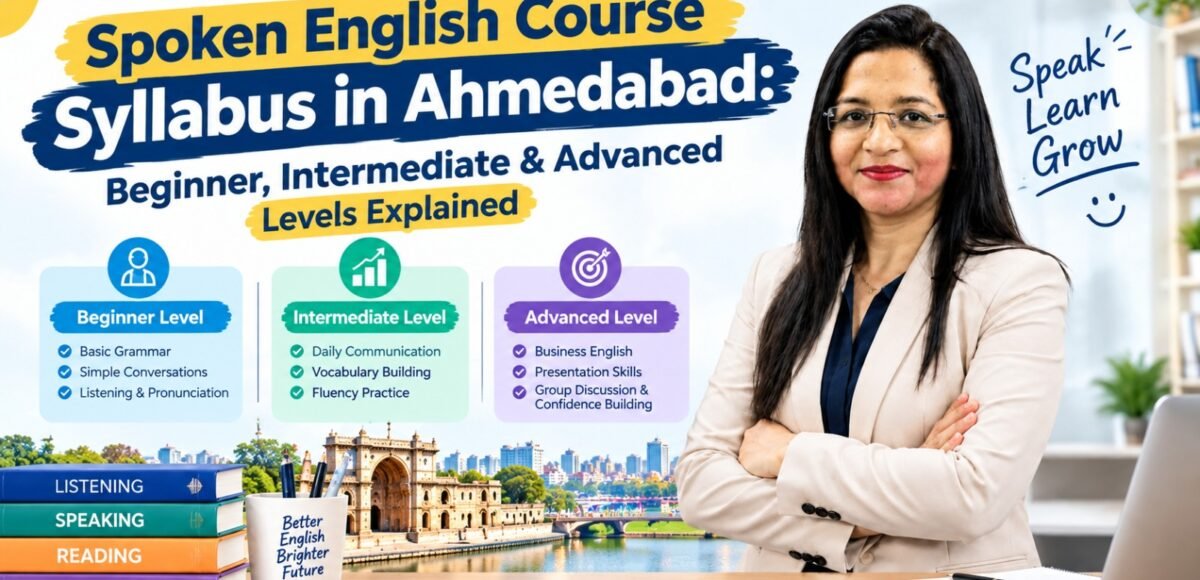
Spoken English Course Syllabus in Ahmedabad: Beginner, Intermediate & Advanced Levels Explained
The syllabus is one of the most important things to check before joining a Spoken English course in Ahmedabad.
A beginner does not need the same curriculum as a working professional who already understands English but struggles with fluency. Similarly, an advanced learner may need professional communication, presentations and public speaking rather than basic grammar lessons.
A well-designed Spoken English syllabus should therefore progress from foundation → conversation → fluency → professional communication.
This guide explains what learners can generally expect at beginner, intermediate and advanced levels and how to choose a syllabus according to individual goals.
Blog Body
Introduction
Knowing English grammar is different from being comfortable speaking English.
Many learners can understand written English but hesitate when they need to speak. Others may know basic vocabulary but struggle to form sentences quickly. Some working professionals may speak reasonably well but want to improve their presentation, meeting or workplace communication.
This is why the Spoken English course syllabus in Ahmedabad can vary depending on the learner’s level and objective.
A beginner needs a strong foundation. An intermediate learner needs more conversation and fluency practice. An advanced learner may require professional communication and public-speaking skills.
Understanding these levels can help you select a course that matches your current ability instead of choosing a program based only on its name.
What Is a Spoken English Course Syllabus?
A Spoken English syllabus is a structured list of language and communication topics covered during a training program.
It can include:
- Grammar
- Vocabulary
- Sentence formation
- Pronunciation
- Listening
- Speaking
- Reading
- Conversation
- Public speaking
- Group discussions
- Presentation skills
- Interview communication
- Workplace English
- Business communication
The exact topics and depth depend on the course level, duration and institute.
Spoken English Syllabus at a Glance
| Level | Main Focus | Typical Topics |
|---|---|---|
| Beginner | Language foundation | Basic grammar, vocabulary, sentences, pronunciation |
| Intermediate | Fluency development | Conversation, advanced grammar, listening, discussions |
| Advanced | Professional communication | Presentations, interviews, meetings, public speaking |
The levels are not necessarily identical across all institutes. Some training centres may use their own level names or assessments.
Beginner Spoken English Course Syllabus
The beginner level is designed for learners who have limited English-speaking ability or lack confidence while speaking.
The primary objective is to build a strong foundation.
1. Basic Grammar
Grammar provides the structure needed to form understandable sentences.
Beginner topics may include:
- Nouns
- Pronouns
- Verbs
- Adjectives
- Adverbs
- Articles
- Prepositions
- Conjunctions
- Basic tenses
- Singular and plural forms
- Subject-verb agreement
The focus should be on using grammar in everyday communication rather than memorizing definitions.
2. Basic Vocabulary
Vocabulary development can include words related to:
- Family
- Education
- Work
- Food
- Travel
- Shopping
- Hobbies
- Daily routines
- Places
- Time
- Common activities
Learners can also practise using new words in sentences.
3. Sentence Formation
Beginners need to understand how to construct simple sentences.
Examples of learning areas include:
- Affirmative sentences
- Negative sentences
- Questions
- Short answers
- WH-questions
- Common sentence patterns
- Everyday expressions
This helps learners move from individual words to meaningful communication.
4. Everyday Conversation
Practical conversations can include situations such as:
- Introducing yourself
- Introducing another person
- Asking for directions
- Ordering food
- Shopping
- Talking about family
- Discussing hobbies
- Talking about daily routines
- Asking and answering simple questions
Role-play activities can make this part of the course more practical.
5. Pronunciation
Beginner pronunciation training may cover:
- Individual sounds
- Word pronunciation
- Common pronunciation mistakes
- Word stress
- Speaking clarity
- Listening and repeating exercises
The objective is understandable and confident speech rather than trying to eliminate every accent difference.
6. Listening Skills
Learners may practise:
- Understanding simple conversations
- Listening to short dialogues
- Identifying key information
- Following basic instructions
- Recognizing common expressions
Listening practice supports speaking because learners become more familiar with natural English.
Intermediate Spoken English Course Syllabus
Intermediate learners generally understand basic English but may experience hesitation, limited vocabulary or difficulty speaking spontaneously.
The focus shifts from learning the basics to using English more naturally.
1. Intermediate Grammar
Topics can include:
- Tenses in greater depth
- Modal verbs
- Conditionals
- Passive voice
- Reported speech
- Question structures
- Relative clauses
- Sentence connectors
- Common grammar errors
Grammar should be connected to real conversations and writing rather than taught only as theory.
2. Vocabulary Building
Intermediate learners can develop vocabulary related to:
- Education
- Careers
- Technology
- Business
- Social issues
- Travel
- Current topics
- Professional situations
They can also learn:
- Phrasal verbs
- Collocations
- Common expressions
- Synonyms
- Antonyms
3. Conversation Practice
Intermediate courses can introduce longer conversations.
Activities may include:
- Pair discussions
- Group conversations
- Situational role plays
- Opinion sharing
- Storytelling
- Describing experiences
- Problem-solving conversations
The objective is to reduce hesitation and improve spontaneous speaking.
4. Listening and Comprehension
Learners may work with:
- Conversations
- Interviews
- Short presentations
- Audio exercises
- Videos
- Different speaking speeds
They can practise identifying the main idea, supporting information and important details.
5. Group Discussion
Group discussions can help learners practise:
- Expressing opinions
- Agreeing and disagreeing politely
- Giving reasons
- Asking questions
- Responding to others
- Summarizing ideas
This is particularly useful for students and job seekers.
6. Presentation Skills
Intermediate learners can begin working on:
- Organizing a presentation
- Introducing a topic
- Explaining information
- Using appropriate vocabulary
- Answering questions
- Closing a presentation
Regular presentations can help develop both language and communication confidence.
Advanced Spoken English Course Syllabus
Advanced learners may already have a reasonable command of English but want greater fluency, accuracy and professional communication ability.
The focus can shift toward professional, academic and public communication.
1. Advanced Grammar and Accuracy
Topics may include:
- Complex sentence structures
- Advanced conditionals
- Complex clauses
- Advanced tenses
- Reported speech
- Modals
- Advanced connectors
- Formal vs informal language
- Common advanced grammar errors
2. Advanced Vocabulary
This may include:
- Professional terminology
- Business vocabulary
- Industry-specific expressions
- Idioms
- Collocations
- Advanced phrasal verbs
- Formal vocabulary
- Persuasive language
Learners should focus on using advanced vocabulary naturally rather than simply memorizing difficult words.
3. Public Speaking
Advanced courses may include:
- Speech structure
- Audience engagement
- Speaking with confidence
- Voice modulation
- Presentation delivery
- Handling questions
- Impromptu speaking
- Persuasive communication
These skills can be useful for professionals, entrepreneurs, teachers and students.
4. Business Communication
Professional communication may cover:
- Meetings
- Client conversations
- Professional introductions
- Telephone conversations
- Business presentations
- Workplace discussions
- Formal communication
- Networking
- Negotiation language
5. Interview Communication
Advanced learners may practise:
- Self-introduction
- Behavioural interview questions
- Professional vocabulary
- Explaining experience
- Answer structure
- Mock interviews
- Handling follow-up questions
6. Professional Presentation Skills
Advanced presentation training can include:
- Structuring a presentation
- Opening and closing
- Explaining data
- Handling questions
- Persuasive speaking
- Professional vocabulary
- Audience interaction
Beginner vs Intermediate vs Advanced Spoken English Syllabus
| Topic | Beginner | Intermediate | Advanced |
|---|---|---|---|
| Grammar | Fundamentals | Intermediate structures | Advanced structures |
| Vocabulary | Everyday words | Wider vocabulary | Professional/advanced vocabulary |
| Speaking | Simple conversations | Extended conversations | Fluent and professional speaking |
| Pronunciation | Basic clarity | Stress and natural speech | Advanced delivery |
| Listening | Simple conversations | Longer conversations | Professional content |
| Group Discussion | Introduction | Regular practice | Advanced discussion |
| Presentation | Basic | Structured presentations | Professional presentations |
| Interview | Basic introduction | Common interview practice | Advanced/mock interviews |
| Public Speaking | Basic confidence | Guided speaking | Advanced delivery |
| Workplace English | Introduction | Practical situations | Business communication |
Spoken English Syllabus for Students
Students may benefit from a combination of language and academic communication.
A student-focused syllabus can include:
- Grammar
- Vocabulary
- Conversation
- Pronunciation
- Listening
- Presentation skills
- Group discussions
- Public speaking
- Interview preparation
- Confidence-building
Students preparing for internships or employment can also consider modules related to professional communication.
Spoken English Syllabus for Working Professionals
Working professionals may need a more practical workplace-oriented syllabus.
Topics can include:
- Business vocabulary
- Meetings
- Presentations
- Client communication
- Telephone English
- Workplace conversations
- Professional introductions
- Networking
- Email communication
- Interview communication
Professionals who already have a strong foundation may not need an extended beginner grammar module.
Spoken English Syllabus for Job Seekers
Job seekers can look for courses that include:
- Self-introduction
- Resume-related communication
- Interview questions
- Mock interviews
- Group discussions
- Professional vocabulary
- Presentation skills
- Workplace English
- Confidence-building
Spoken English can support interview communication, but technical qualifications and job-specific skills remain important.
Practical Training in a Spoken English Course
A strong syllabus should not be limited to textbook exercises.
Practical activities may include:
Role Plays
Learners practise real-life situations such as interviews, shopping, meetings and customer conversations.
Group Discussions
Students discuss a topic and practise expressing opinions.
Presentations
Learners prepare and deliver short presentations.
Mock Interviews
Students practise answering common interview questions.
Conversation Practice
Learners speak with partners or groups.
Pronunciation Exercises
Learners practise difficult sounds and receive feedback.
Practical activities can turn theoretical knowledge into usable communication skills.
Spoken English Course Duration and Syllabus
The syllabus often depends on the course duration.
| Duration | Possible Focus |
|---|---|
| 1 Month | Basic grammar, vocabulary and conversation |
| 2–3 Months | Foundation + regular speaking practice |
| 3–6 Months | Intermediate and advanced communication |
| 6+ Months | Comprehensive/professional communication |
These are general patterns rather than fixed industry standards. Each institute may structure its course differently.
How to Choose the Right Spoken English Syllabus in Ahmedabad
Before joining a course, ask the institute:
- What level is the course designed for?
- Is there a level assessment?
- What topics are covered?
- How much speaking practice is included?
- Is pronunciation taught?
- Are group discussions included?
- Are presentations included?
- Is interview preparation available?
- Is workplace English covered?
- How often will learners receive trainer feedback?
These questions can help you identify whether the syllabus matches your needs.
Why Practical Speaking Should Be Part of the Syllabus
A learner may understand grammar rules but still hesitate during a real conversation.
Practical speaking activities can help learners practise:
- Quick sentence formation
- Vocabulary recall
- Pronunciation
- Listening responses
- Confidence
- Conversation flow
The goal should be to gradually move from understanding English to actively using English.
How to Practise English Outside the Classroom
Regardless of the course level, regular practice is important.
Try a simple routine:
10 minutes: Read English aloud
10 minutes: Listen to English conversations
10 minutes: Speak about a familiar topic
5 minutes: Learn useful vocabulary
5 minutes: Review mistakes
You can also practise by:
- Recording your voice
- Speaking with a friend
- Describing your daily activities
- Watching English videos
- Reading articles aloud
- Participating in discussions
Spoken English Classes in Ahmedabad
Learners can search for Spoken English courses across several Ahmedabad areas, including:
- Navrangpura
- C.G. Road
- Satellite
- Vastrapur
- Thaltej
- Bopal
- Prahlad Nagar
- Maninagar
- Naranpura
- Memnagar
- Chandkheda
- Ghatlodiya
- Nikol
- Naroda
When choosing a local institute, consider location along with syllabus, trainer support, course duration, fees and practical speaking opportunities.
AEO: Frequently Asked Questions
What is included in a Spoken English course syllabus?
A typical syllabus can include grammar, vocabulary, sentence formation, pronunciation, listening, conversation, group discussions, presentations, public speaking and interview or workplace communication.
What is the beginner Spoken English syllabus?
Beginner courses generally cover basic grammar, vocabulary, sentence formation, pronunciation, listening and everyday conversations. The exact topics vary by institute.
What is taught in an intermediate Spoken English course?
Intermediate courses generally focus on conversational fluency, expanded vocabulary, intermediate grammar, listening, group discussions, presentations and situational communication.
What is included in an advanced Spoken English course?
Advanced courses may include professional communication, business English, public speaking, presentations, meetings, interview skills, advanced vocabulary and complex grammar.
How long is a Spoken English course in Ahmedabad?
Course duration varies. Some programs may last around one month, while comprehensive courses can continue for three, six or more months depending on the syllabus and learning goals.
Is the Spoken English syllabus the same for every institute?
No. Institutes may use different course structures, levels and teaching methods. Always review the actual syllabus before enrolling.
Which Spoken English level should a beginner choose?
A learner with limited speaking ability should generally start with a beginner or foundation-level course. An assessment or demo class can help determine the appropriate level.
Is Spoken English useful for job interviews?
Yes. Interview-focused Spoken English training can help learners practise self-introduction, professional vocabulary, common interview questions and mock interviews. It does not guarantee employment.
Does Spoken English training improve fluency?
Structured training and regular practice can help improve speaking ability. However, progress varies between learners and depends significantly on practice, attendance and starting level.
Should working professionals choose an advanced Spoken English course?
If a professional already has basic English skills but wants to improve meetings, presentations, client communication or business conversations, an intermediate or advanced professional communication course may be appropriate.
Conclusion
The Spoken English course syllabus in Ahmedabad can vary considerably depending on the institute, course duration and learner level.
At the beginner level, the focus is usually on grammar, vocabulary, sentence formation, pronunciation and everyday conversation. The intermediate level moves toward fluency, longer conversations, group discussions, presentations and more complex language structures. The advanced level can focus on professional English, public speaking, interviews, meetings, presentations and business communication.
Before enrolling, do not look at the course title alone. Check the complete syllabus, practical speaking activities, trainer support, batch size, duration, assessment and learning format.
Most importantly, choose a level that matches your current ability and goal. With structured training and consistent practice, learners can gradually develop more confident and effective English communication skills.